- Financial Mistakes that Newlyweds Make
- The Poultry Project 3: First Feathers
- The Poultry Project 2: Quills!
- The Poultry Project: 1… Peeps!
- Appalachian Spring: Ramp Season!
- How To Build A Log Cabin
- Tiny Houses: Part 2
- The Vernal Equinox
- Stocking Upon Gas By Season
- Natural Car Cleaners
- Activities
- Agritourism
- Alternatives
- Barter
- Biofuels
- Building
- Cash Crops
- Cheesemaking
- Community
- Conservation
- Container Gardening
- Cooling
- Cooperatives
- Cultivated Herbs
- Dairy
- Doors
- Economics
- Education
- Emergency Preparedness
- Endangered Species
- Energy
- Environment
- Family
- Farm Policy
- Finance
- Food Preservation
- Food Production
- Food Safety
- Food Storage
- Future Planning
- Garden
- Glazing
- GMOs
- Goats
- Harvest
- Health
- Heating
- Herbal Medicine
- Holidays
- Home Buying
- Home-Products
- Homestead
- Hunger
- Independence
- Indoor Plants
- Jobs
- Landscaping
- Livestock
- Log Construction
- Maintenance
- Medicine
- Money
- Monsanto
- Nutritition
- Pets
- Planters
- Pollution
- Porch Plants
- Poultry
- Rare Plants
- Recipes
- Recycling
- Renovating
- Repair
- Rural Development
- Schools
- Soap Making
- Solar
- Sustainable Living
- Taxes
- Timber
- Time-Management
- Tools
- Trade
- Transportation
- Uncategorized
- Vacations
- Water
- Wild Foods
- Wild Herbs
- Wind
- Windows
- Wine
- Yard
- May 2012
- April 2012
- March 2012
- February 2012
- January 2012
- December 2011
- November 2011
- October 2011
- September 2011
- August 2011
- July 2011
- June 2011
- May 2011
- April 2011
- March 2011
- February 2011
- January 2011
- December 2009
- November 2009
- October 2009
- September 2009
- August 2009
- July 2009
- June 2009
- May 2009
- April 2009
- March 2009
- February 2009
- January 2009
- December 2008
- November 2008
- October 2008
- September 2008
- August 2008
- July 2008
- June 2008
- May 2008
- April 2008
- March 2008
- February 2008
- January 2008
- December 2007
- November 2007
- October 2007
- September 2007
- August 2007
Homestead Innovations: Growing Power
August 8th, 2011

Sunhorse 4812 All Electric Tractor
One of the biggest long-range planning issues involved in making a successful transition from a seriously inefficient and wasteful fossil fuels economy toward a more healthy renewables-based way of life is the problem of our petro-based system of agriculture. Those huge tractors and combines that dominate the endless landscapes of Big Agri-biz operations can translate into an entirely unsustainable 10:1 ratio of fossil fuel use to food on the table. Obviously as the cost of petroleum fuels keeps on rising, our society at large must come up with more efficient alternatives. Fortunately, there are a couple of alternatives that bode well for the future.
Huge swaths of the American breadbasket where staple monocrops are produced by the square mile would probably be better off going with Rudolph Diesel’s engine which he invented in 1893 to run on peanut oil. The Big machines could be run on SVO biodiesel that could be produced in a centrally located co-op type operation from oil crops cooperatively grown just for the purpose. These could then power the growing of those massive amounts of staple crops like oilseed, sugar beets, corn and other grains needed for both humans and livestock that are most efficiently produced by agribusiness concerns. Less petroleum consumption for this purpose, combined with programs aimed at lessening big ag’s dependence on petro-based chemical fertilizers, herbicides and pesticides would help a lot.
But is biodiesel the best alternative to the small producer? Smaller, more diverse farms, organic operations and homesteads that participate in Community Supported Agriculture programs and/or agritourism offerings don’t need those huge multi-purpose machines to grow just a few acres’ worth of truck crops, culinary herbs, grains, etc. Luckily for us small-timers, there’s electric tractors.
Filed under Agritourism, Alternatives, Biofuels, Energy, Environment, Food Production, Garden, Home-Products, Homestead, Solar, Sustainable Living, Tools | Comment (0)Houses of Straw
July 29th, 2011

Leonard Leslie Brooke illustration
Sure, we all remember the children’s story about three pigs and a big, bad wolf, who could huff and puff and blow the house down (unless it was made of bricks). The stick house held up a little bit better, but the straw house didn’t provide much in the way of protection at all. But these days, houses made of straw and stucco are getting quite sophisticated. Even looking sturdy enough to stand up to a good, stiff breeze, whether it comes from a wolf or a hurricane.
Bales of straw (usually wheat straw) as building material isn’t exactly new, though perhaps not as old as the Three Little Pigs tale. late 19th century homesteaders out on the Nebraska plains are credited with building the first straw bale and mud-wattle houses, much as Oklahoma homesteaders pioneered stone and earth-sheltered homes with sod roofs. These early examples of hardy home-building with whatever’s handy largely escaped modern notice until the early 1970s, when the hippie “back to the land” movement took off. Most straw bale houses built over the following couple of decades were non-code off-the-grid shelters, but the benefits of bale construction have gained new fans.
Featured in this New York Times article is a rather spectacular example in the Catskills hand-crafted with loving care over a period of years by Clark Sanders. For the new revival in homesteading pioneers for the 21st century, there are a number of outfits and websites offering education in straw bale building techniques, helpful hints, and contacts for associated material like stuccos and plasters, wall lattice, etc. Some of the most interesting and useful are listed below. There are even some very nice straw bale house plans that can be built as offered or altered to your own site’s needs and combined with other green technologies such as earth sheltering, etc.
A relatively small straw bale shelter could be built fairly quickly and cheaply by new homesteaders on their land as a place to live while developing the various water and energy systems that will support something more permanent at a later date. If sited well and built sturdily, such a shelter built into a berm or hillside could later serve as a well-insulated root cellar for food storage, or a cool shelter barn for ruminant livestock. Just be sure your plastering job keeps up with the normal wear and tear of time, or the livestock just might eat their own barn!
Check out some of the listed sites and their offerings, see if straw bale construction might serve you well in some application. All told, the recurring benefit theme of this construction method is low cost. Which is always something modern homesteaders need to consider.
Links:
Straw Bale Construction
StrawBale dot Com
Bale Watch: 50 House Plans
A House of Straw
NYT: Bale by Bale, Stone by Stone
Livestock: A Rabbit In Every Pot
July 26th, 2011
I’ve been looking into the various classified ads locally for livestock I want, to get an idea on budgeting first for proper quartering and actual animals. Chickens are of course a first choice. Also want bees, been looking at hives and queens for sale. If I can site them properly, bears shouldn’t be too much of a problem. Goats are sometime in the future, will need more fencing than we’ve got.
On those classified pages I discovered an awful lot of meat rabbits for sale, and remembered some homesteader friends in Virginia about 25 years ago who were big into meat rabbits. At the time we’d recently become vegetarian and I rejected the idea for our just-started homestead, but all these years later I think the ease of raising rabbits might make them an excellent livestock choice… so long as I don’t have to be the one who slaughters and prepares them for sale. There are surprisingly ample markets locally for good rabbit meat, especially organically raised. Even including some of the high-end eateries and B&Bs who are my regular fresh organic herb and sauce customers.
Filed under Alternatives, Cash Crops, Economics, Food Production, Future Planning, Homestead, Independence, Livestock, Nutritition | Comments (2)Vertical Wind Growing [Straight] Up
July 25th, 2011
As the energy situation in this country becomes more and more frustrating due to a myriad of factors such as costs, aesthetics and a troubling amount of stonewalling by rich, organized fossil fuel and nuclear die-hards, it’s nice when research and development produces technologies that can answer some of the most frustrating objections to renewable energy.
Here in the western North Carolina mountains – where the wind blows stiffly enough on the high ridge lines to cause constant issues with the myriad tall radio transmitter and cell phone towers that mark them with flashing lights high above the tree lines, some pretty underhanded lobbying by rich developers and the Big Energy lobby (nuclear and coal from MTR mining) amended the state’s 1983 Mountain Ridge Protection Act to exclude the windmill exemption (but of course keeping the radio and cell tower interpretations in place). Now, the Act only applies to ridgelines over 3,000 feet in elevation, which would apply primarily to the Blue Ridge debarking the eastern continental divide and the “J” shaped ridgeline of the Black Brothers, including Mount Mitchell and several others among the highest peaks east of the Mississippi River.
Filed under Alternatives, Energy, Environment, Future Planning, Homestead, Independence, Wind | Comment (1)Teeny, Tiny Houses
July 11th, 2011
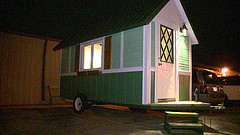
A friend left a little 16-foot travel trailer in our back yard a couple of years ago when he had to sell his land and move east to tend his aging parents. The plumbing got wrecked because he forgot to unhook it before pulling it out, but the electricity’s still fine, and I’m presuming the stove, fridge and heat would work if we cared to replace the propane bottles. We’ve been using it as a combination storage shed and guest bedroom, but had to drape a tarp over the roof to stop leaks in the corners that led to a nasty accumulation of mildew.
What I’d most like to do is convert it into an actual camp-cabin style “Tiny House” that would blend in with the forest scenery better than white with turquoise trim on your basic aluminum trailer siding. Maybe build a Tiny House shed while we’re at it as well. Tiny houses are often built on wheels to get around local building codes, and of course this trailer is already on wheels. But that’s not really necessary here because there are no building codes out in the wilderness – unless you wish to obtain insurance, that is.
Of course, we could probably do better by selling it cheap just to get it hauled out of here, and then building a little camp cabin instead. By building from scratch we could get more width and height out of the space, which goes a long way in the ‘tiny house’ realm toward making the space usable and comfortable at the same time. Wish some help from our grandsons we could probably supply all the logs necessary from right here on the land, though I’d still need that mule I’ve been meaning to get in order to get them transported from where we cut to where we want to build.
Filed under Alternatives, Building, Economics, Environment, Future Planning, Home-Products, Homestead, Log Construction, Solar, Sustainable Living | Comment (1)Human Pedal-Powered Power
July 5th, 2011
As part of our plan to revamp our water supply system to get rid of the energy-sucking 220 pump and replace it with a ram jet, and concurrently installing geothermal collectors to supply a steady supply of cool air in summer and warmer air in winter, I’ve been checking into other ways of cutting our grid energy use. It will be years before we’re in a position to purchase solar panels or a wind generator to get the homestead off the grid entirely, so every little bit of electricity we don’t use from Duke Energy helps our bottom line.
A friend in Arizona long known for his bicycling prowess sent me a link to David Butcher’s Pedal Powered Generator website, which is chock full of information about getting a little exercise while charging up some batteries used to operate things like LED lights, computers, televisions, electric motors on your assisted transportation (Moped), even a washing machine. Though that last takes some real muscles for the spin cycle. I’ve often thought that as I’m sitting here at my desk surfing around on the internet I should be pedaling a stationary bike to power the machinery that lets me do that.
Filed under Alternatives, Conservation, Energy, Future Planning, Home-Products, Independence, Renovating, Sustainable Living | Comment (0)Savvy Family Savings: Tips to Lower Your Expenses
June 29th, 2011
The old adage is true – money certainly doesn’t grow on trees. In fact, when you have a family, money can seem to be scarce fairly frequently. As the number of people in your household goes up, unfortunately, so do expenses.
However, there are many ways you can help your family save some much needed cash. These can be small savings like cutting down your dining out expenses to large savings like adding bundled services like satellitestarinternet to help you cut down costs. Using the savvy saving tips listed below will help you keep an eye on that penny jar and watch it grow into some significant savings!
Extend Your Family Phone Plan
Most of the time, phone companies are quite happy to offer you savings depending on the number of people you have included in your phone plan. Why not take advantage of this by including external family members as well as your nearest and dearest?
Grandparents, aunts, uncles and even cousins can all be included to help you save money. So you don’t talk to them every week – so what? When you do, at least you can be sure that you are making some substantial savings by having them on your phone plan!
Starbucks seems to come under a lot of heat these days. Whether people are blaming the company for deforestation or simply just complaining that it is taking over Main Street, someone always has something bad to say about it. Well, you can do your part by avoiding take-out coffee altogether!
The average cup of coffee from Starbucks costs around $3 – if you add up all the mocha lattes you’ve had over the years, that comes to quite a large amount. Make your own coffee at home if you simply can’t do without your caffeine fix.
Every family needs a break once in a while, and it can be good for you to get out of your comfort zone and visit a new city or country. However, who says that it needs to cost you an arm and a leg? Although hotels are often relaxing and it can be pleasant to be waited on hand and foot, they can also be very expensive.
Hostels, on the other hand, cost a pittance compared to the price of an upscale hotel. Sure, you may have to share your room with a group of drunken backpacking German students, but at least your family will have an abundance of stories to tell in years to come!
Every family needs to spend money regularly on necessities such as food and bills. Despite this, there are many everyday activities that cost money that can be eliminated altogether, such as going to the barber. Nobody is suggesting that you let your family become a gang of long-haired ‘flower children,’ but you can save a few dollars here and there by cutting your own hair.
This is particularly good if you have small boys, as they hate going to the barbers at the best of times. Of course, probably the cheapest and quickest way of doing this is to shave your head – but it would take a brave family to do this all at the same time!
Children’s birthdays can often be expensive occasions – what with the presents and the party favors, the costs can soon mount up. However, if you have two children, you can slim costs down by throwing two birthday parties on the same day.
This will ensure that you are only spending money on cake and ice-cream for one big event during the year, rather than two. If you are particularly skilled with a calendar, you could even try to conceive your children so that they are born around Christmas time – that way you can roll Christmas and birthday into one, as well!
The weekly grocery-store shopping trip is one of the largest expenses a family can have. If you want to cut down on this large bill, you can make sure your family eats simple food like soup.
You can still put plenty of vegetables into the soup so that your family is getting the required amount of nutrients, but it is certainly better for your purse strings than buying steak once a week! So cut down the meat, and enjoy your vegetable soup.
The sad fact is items like clothing wear out over time and begin to get holes in them. When this happens, the natural reaction is to throw out old garments and go on a shopping spree to replace them. However, this is a definite drain on your financial resources, so pick up a sewing needle and thread and darn, darn, darn!
If your clothes are really beyond saving, you can always use items like old shirts as rags for dusting or cleaning the house – anything other than simply throwing them out and having to buy new things!
It is a well known fact that school fees in the US cost a lot more than in other countries. Not only do most European students study for a shorter time than their US counterparts (which keeps their fees down), but the overall costs are usually much lower as well.
Of course, everybody wants the best education possible for their child, but if you find that you might be struggling to keep up with the tuition payments, it is worth considering colleges abroad where your child might get more brains for their bucks. Just make sure you keep the exchange rate in mind when signing up for a course!
CONCLUSION
Having a family is expensive in this day and age. However, by following the above tips you can help keep your essential expenses down and make it easier for everybody to make ends meet.
Images
flickr.com/photos/36-degrees/1401973209/in/photostream/
flickr.com/photos/globalreset/19606816/in/photostream/
flickr.com/photos/upturnedface/2422039706/in/photostream/
flickr.com/photos/nevercoolinschool/3040426247/in/photostream/
flickr.com/photos/kwbridge/1801042803/in/photostream/
flickr.com/photos/nicktakespics/3748516748/in/photostream/
flickr.com/photos/shhhitsneia/4490475619/in/photostream/
flickr.com/photos/jimmyharris/2524588482/in/photostream/
Inventing a Geothermal System
June 27th, 2011
As plans for the new water system move forward, we find ourselves in sudden possession of quite a lot of high-end good-sized PVC piping of various lengths, assorted odd couplings, some strips and scraps of new carpeting (good for insulation of trenches), and a surprising amount of aluminum ductwork. Salvaged from various places. Not being content to leave what look to be perfectly good but not immediately needed lengths of such pipe and ducting behind, we’ve been rescuing as much as we can get from the dumpster-side repository at the contracting facility next door to hubby’s day job.
Some of these lengths of thick-walled new pipe are 3 or 4 inches in diameter, so I’ve been considering how we could use them as we head into this major project, other than as the ‘head’ flow from the new spring to the ram jet in the pumphouse. Given as it’s nearly July, I have also been scouting around for some form of air conditioning that doesn’t require an air-tight home and way more not-cheap electricity than we care to use. We only need it occasionally during the hottest hot-spells of summer and only at times when it’s inconvenient to spend the afternoon in the basement, out under the shade trees, or down at the swimming hole. As part of that research, I’ve been looking at geothermal engineering concepts and technology as well as at modern iterations of good old evaporative cooler (a.k.a. “Swamp Cooler”). Which looks great and works well in places like Arizona, but is not so great here in the southern Appalachians where it’s around 85-90% humidity all the time. Geothermal still looks good, so…
A Do-It-Yourself heat pump! But without the compressor/heat element assist. This could work.
Filed under Alternatives, Building, Conservation, Cooling, Energy, Environment, Future Planning, Heating, Homestead, Renovating, Yard | Comment (1)Water Issues: Ram Jet or Spiral Wheel?
June 22nd, 2011
Things always seem to break down all at once instead of breaking here and there over a year’s time so it isn’t always a big crisis. This spring our daughter blew the pickup truck’s engine (her second in two years), the regular car blew its rear end, and the spring water cistern developed several hefty leaks. The bad car karma is nothing too unusual for struggling homesteaders who never buy new, something will come along soon that will get us from here to there and home again until it breaks down too. The water situation is much more pressing, something absolutely must be done about that right away.
We generously applied some sealant to the inside of the cistern, but it’s still leaking to the point that I can’t do a load of laundry and wash the dishes on the same day. So we’ll have to do the job this summer, and I’m thinking it’s time to go ahead and do what I’ve always wanted to do – put the cistern up on the ridge so we can have gravity feed to the house, and somehow get the water from the source to the cistern without having to use a 220-volt electrical pump. Which is about half our hefty electric bill every month, so whatever we do would be paid for in less than a year.
Filed under Alternatives, Building, Energy, Future Planning, Homestead, Water | Comment (1)Milk Thistle Harvest – A Powerful Herb
June 16th, 2011
Today I managed to get out into the garden before noon for a little clean-up and prep. Took out the last of the early peas and radish pods from their nifty PVC tent with twine, the peas being well past done and the pods perfect for harvest. I’ll need to clean out the bed thoroughly to replant with pole beans, and I will replant radishes down below in a bare well-composted spot next to the potatoes (which are blooming great guns!).
I also donned leather gloves and de-headed the milk thistle [Silybum marianum]. They were as tall as me by this time, falling over from heavy heads to make it difficult to get past them to the rest of the garden. Those dry pods are spiny like you wouldn’t believe, as if the leaves weren’t bad enough, but all spring the leaves make great additions to salads and pot greens, very pretty variegated thick foliage you have to trim the spines off of before adding to anything. The flower heads – the usual pretty purple thistle flowers about the size of a golf ball – produce seeds that are readily marketable to herb dealers in our region, but we end up using most of them ourselves for skin treatments, general systemwide cleansing, etc.
This stately and strikingly pretty plant has been in use for more than 2,000 years as a remedy for all sorts of ailments, most notably liver and gall bladder problems. There have even been medical studies of milk thistle as a remedy for liver damage caused by pain medications such as acetaminophen. Its flavonoid Silymarin is antioxidant and anti-inflammatory, and its action on the liver appears to be stimulation of new cell growth in that organ.
Filed under Alternatives, Cash Crops, Cultivated Herbs, Garden, Health, Herbal Medicine, Homestead, Medicine, Recipes, Yard | Comment (1)