Disrupting the Way We Buy Produce

September 29th, 2011
farmigo

Straight from the TechCrunch Disrupt Battlefield, a new internet-based project to greatly expand the CSA [Community Supported Agriculture] movement into places where it hasn’t been before. It’s a project designed to connect community organizers – volunteers with a group of friends and neighbors who want to get in on farm fresh produce and other fresh foods – to buy in to local suppliers in the usual CSA manner and set up a drop-off point in their area for deliveries and for members to pick up their weekly food items. The company, farmigo, acts as the middleman to negotiate directly with growers, coordinate deliveries and scheduling, and handle the nitty gritty of the business end. It also maintains the web-based platform for people to manage their accounts, order food, and pay the fees. To support this effort, farmigo receives a 2% fee on food sold and collects this from the producers rather than from the customers.

The idea isn’t entirely new, as CSAs in some regions have already set up their local businesses through websites, and even pooled with other suppliers to make for convenient ordering of variety items and coordinate deliveries. Farmigo is pretty much the same type of thing, but on a much larger scale and including big city dwellers. The farmers, fishermen, butchers and bakers who offer products through the service still get to set their own terms and commitment periods. When you check into the website you can click on a map to receive a list of suppliers in your area with links and information on already established drop-off sites.

Farmigo also facilitates one-time ala carte purchases of things like eggs, flowers, meats, seafood, baked goods and other things that will be delivered to the drop-off point on your usual days, so the customer isn’t limited to whatever crops are being harvested at any given time on their CSA’s farm, but isn’t corralled into long-term purchase contracts with those other suppliers. This also saves the member/customer the trouble of driving around to several different drop-off points to get their food allotments. Some suppliers will even deliver to your home, depending on where you live and the nature of your orders.

Continue reading »

Corporate Food & Human Backlash

September 26th, 2011
FDAinspectors
FDA, via AP

The current collapse of the world financial system has revealed some structural problems in our national economy that have flourished over a period of decades as corporate interests bought politicians and lobbyists to craft legislation to remove legal roadblocks to mass theft and market manipulation. And despite some changes in the D.C. political landscape, our government remains apparently helpless to do anything about corporate malfeasance on any level. With all the bad economic news dominating the public consciousness, some issues in the food supply sector are having a difficult time being properly correlated and attended to despite the serious level of danger they present to public health.

The food supply issues didn’t begin with the market manipulations on Wall Street and from there to exchanges all over the world. Though for many people the first alarms went off as the CDS fraud crashed the economy in 2008 and the financial players went looking for other markets to wreak havoc on. They seized on commodities – staple foods from the agricultural sector increasingly dominated by multinational corporations like Monsanto, ADM and Cargill. As a traceable beginning in 2008 to what this year became the “Arab Spring” movement across North Africa and spreading to the Middle East and southern Asia, food riots broke out in Egypt and Syria and portions of India as well as elsewhere when people could no longer afford to feed themselves and their families. Things have only gotten worse in the years since, and Americans are slowly waking up.

Continue reading »

Fall Plantings: Garlic

September 14th, 2011
garlic1

With the Harvest Moon just a couple of days past, the last of the summer crops will be coming in over the next month to be properly stored and/or preserved. The big pears are finally falling, providing more than enough for as much pear butter as I can possibly make even as the deer and turkeys work hard to eat more than their share before I can gather. The pumpkins are good and orange now, but can stay on the vines until first freeze warnings before I have to harvest and process. Winter squash is looking to be a good harvest at the same time, and the peppers are quickly turning red in rushes. Grape tomatoes are being sun-dried to “tomaisins,” as many as I can fit into the solar dryer at a time and always many more waiting to be picked. They’ll keep right on coming until first freeze.

At the same time, as the beds are cleared from harvest they must be prepped for fall plantings. More kale and collards (which will keep going all winter into spring with plastic tenting on very cold nights), peas, lettuces and spinach, and of course garlic. Today I’m talking garlic, because it’s one of our most favorite garden goodies.

Garlic is a member of the onion [allium] family. It has powerful antibiotic properties, and is well known as a “blood purifier” and digestive stimulant. Legend has it that garlic is an effective vampire and werewolf repellant, but I haven’t heard that it will prove to be all that useful during the coming Zombie apocalypse. For that, you should follow the advice in The Zombie Survival Guide instead.

Continue reading »

More Things to Do With Peppers

August 30th, 2011
Ristra
Festive holiday ristra

In my last post I went into some detail on how easy it is to preserve peppers by pickling. And while I do pickle quite a lot of the range of hot peppers I grow every year to supply my heat-loving family and friends and allow for the several levels and types of hot pepper sauces I make for steady customers in my region, my favorite thing to do with hot peppers is to dry them.

The sauce and pot peppers, as well as sweet peppers and mild chilis like poblanos are usually frozen whole or chopped in zip lock freezer bags. It’s easy to break off a chunk and toss into any dish I’m making, and this is to my taste buds the best way to preserve sweet bells. But if you grow a lot of hot chilis like I do, there’s much more you can do through the culinary year with dried peppers than with frozen or pickled or otherwise canned.

I have found some good sources for detailed information on drying peppers and what to do with them afterwards, listed at the bottom of this post. I prefer to sun dry – in my nifty home-made solar dryer out on the front deck – but chilis can easily be dried in a commercial dryer, in the oven on its lowest setting, or in the sun directly if they’re kept whole. Flies and other insects don’t like to congregate on rip hot peppers left in the sun, as they will on tomatoes or other vegetables and fruits that are sliced and placed in the sun to dry. Thick-walled chilis like Anaheims, jalapenos, etc. take longer, of course. Fingerhots, cayennes, thai hots, etc. will dry hard and crisp in just a few hours of sun. Presuming you don’t live in a super high humidity environment, of course.

Continue reading »

My Peck of Pickled Peppers

August 29th, 2011
PepperPickles

As the various crops come in – for summer crops that is July through September in my zone 5 here in western NC – I’ll be writing about various methods of preservation. Two weeks ago it was tomatoes. Bushels and bushels of tomatoes. Last week it was the first pints of pear butter (the pears are by no means done falling, so there will be more). This week it’s peppers.

The main pepper crop will not be fully ripe until mid-September, but some bells, cayennes, thai hots, anaheims, poblanos, jalapenos, habaneros and hot banana peppers are making it into the house day to day. By the number of chilis on my pepper list readers may safely surmise that the family and friends of this homestead are fond of peppers with some heat to them. My menfolk subscribe to the culinary philosophy that a good pot of chili and/or beans is hardly worth eating unless it clears out your sinuses and makes you sweat. Things that chili powders, crushed dry peppers, pickled peppers and an assortment of hot sauces ranging from merely Cajun through 3-alarm and Nuclear all the way to Satanic are quite famous for providing.

Capsaicin and a range of capsaicinoid relatives produced by chili peppers are the compounds which provides the heat in peppers. These are classified as irritants to mucus membranes and increases secretion of gastric juices. The hotness (irritant level perceived as heat by nerves, even though the hottest peppers cannot really burn tissue) is measured in Scoville Heat Units [SHUs]. Bell and Cubanelle peppers rate a zero on the scale, with no appreciable hotness. Pimentos and regular banana peppers rate between 100 and 900 SHUs. Anaheims and Poblanos rate 1,000 to 2,500 SHUs, jalapenos 3,500 to 8,000, habaneros can weigh in at 100,000 to 500,000. The hottest peppers – the Peruvian ghost pepper , bhut jolokia peg the meter at a million SHUs or more. You do not want to take a bite out of one of these just to impress your friends at the bar.

Continue reading »

Pears, Pears, Pear Butter!

August 27th, 2011
TheMightyPear
My Mighty Mama Pear Tree

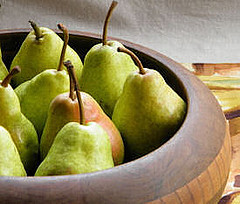
It’s that time of year again. That late August period when “the world’s biggest pear tree” and all its younger offspring start dropping those little rock-hard cinnamon pears of mysterious variety onto the driveway to be turned into pungent pear mash that draws literal herds of deer, any passing bear within sniffing distance, flocks of turkeys and gaggles of raccoons who can never quite keep up with the bounty.

The big pear tree is 60 feet tall and more than two feet in trunk diameter. It is at least that many years old, all that remains of the original orchard on the property. It’s gorgeous in bloom in the early spring, but quite a headache in late summer as it draws so much wildlife along with swarms of yellow jackets who feast on the mash and rotting fruit beneath the tree and its offspring. About the size of plums, these are not pears that one can readily eat straight off the trees, though they do tend to survive the fall much better than those big commercial pears do. Best I’ve been able to figure from the history of this homestead over 100+ years, the orchard on the high land was planted to support the corn in the bottom land, as part of the sweet mash destined to become moonshine – something of a claim to fame for this region for a bit more than 200 years all told.

Pears are a fruit that isn’t truly ripe until after they’ve been off the tree for a day or two. My pears are not soft even when ripe-ripe. That should serve as a caution to readers who want to try my “easy to do” recipe below for making pear (or apple) butter and are using those big, luscious commercial pears rather than these semi-wild old-timey heirlooms. Those big, soft pears will cook down to mush much quicker than mine.

Continue reading »

Tomatoes, Tomatoes Everywhere!

August 16th, 2011
tomato-harvest

Bags and boxes and baskets of tomatoes. Romas and Abe Lincolns and some other determinate heirloom I forget the name of. All ruby red and threatening to rot if not processed immediately, no human being can eat enough tomato sandwiches to dent the load.

So it’s been days’ worth of boiling water to loosen skins, a quick cold water bath, peeling, seeding coring, chopping. Having to do it in shifts to give my hands enough time to recover, hoping they don’t turn permanently wrinkled from the effort. Putting up quarts and quarts of tomato juice for drinking just because I can, and we love straight, watery tomato juice. Other boiling pots containing onion ends, the last of last year’s dried leeks and celery, fresh spices, some cuke ends and peels, pole bean pods and such, the accumulated compost of a vegetarian household added to those tomato skins and seeds and cores and trimmings to make broth for soups and stews and greens and those big wintertime pots of beans. Then to can it all in jars and put it away for later consumption.

Canned quarts of quarters. Frozen bags of chunks. Fresh tomato basil soup and tomato sandwiches and good ol’ ‘mater pies… it’s a wonder we haven’t all turned into tomatoes ourselves! And for the bulk of the gleaned harvest (the field entirely organic), drying. The solar dryer has been full of tomato quarters and chunks for days now, as much as that very nifty south porch unit can hold. The sun dries them just enough to move indoors in the evening when the sun goes down, into the oven on its lowest setting of 160 degrees, propped a little open with a spare canning ring, to finish the job. Meanwhile flats of fresh quarters and chunks get prepped for the solar dryer when the sun comes up. Start the whole process over again. Ripest fruits first because this sort of thing takes days and these babies are indeed very ripe.

Continue reading »

Gleaning the Fields

August 11th, 2011
gleaning-ruth
Ruth Gleaning the Fields

In my last post, Hunger in America, I mentioned several ways we homesteaders could participate in helping to get food into the bellies of our neighbors who are going hungry, and whose supplemental aid is being slashed wholesale by the government. The situation is not going to get better any time soon, so an expansion on the notion of gleaning fields in your rural area is timely.

On a visit to my sister who lives south of our homestead near the South Carolina border brought the situation home to us graphically last week. I’m sure most have heard about farm labor shortages in a number of states this season, which have left fields planted in the spring and early summer to rot in place. On our drive to Sis’s we go past a fairly extensive truck farm with acres of tomatoes, cucumbers, squash, melons, pumpkins, sweet corn, etc. that until last year supplied area groceries with fresh local produce and a big produce stand managed by the Mexican-American family who owns the land. We noticed with some shock that the crops were literally rotting in the fields right next to the road and going back for half a mile in both directions – something we’d never seen before.

Continue reading »

Homestead Innovations: Growing Power

August 8th, 2011
Sunhorse4812
Sunhorse 4812 All Electric Tractor

One of the biggest long-range planning issues involved in making a successful transition from a seriously inefficient and wasteful fossil fuels economy toward a more healthy renewables-based way of life is the problem of our petro-based system of agriculture. Those huge tractors and combines that dominate the endless landscapes of Big Agri-biz operations can translate into an entirely unsustainable 10:1 ratio of fossil fuel use to food on the table. Obviously as the cost of petroleum fuels keeps on rising, our society at large must come up with more efficient alternatives. Fortunately, there are a couple of alternatives that bode well for the future.

Huge swaths of the American breadbasket where staple monocrops are produced by the square mile would probably be better off going with Rudolph Diesel’s engine which he invented in 1893 to run on peanut oil. The Big machines could be run on SVO biodiesel that could be produced in a centrally located co-op type operation from oil crops cooperatively grown just for the purpose. These could then power the growing of those massive amounts of staple crops like oilseed, sugar beets, corn and other grains needed for both humans and livestock that are most efficiently produced by agribusiness concerns. Less petroleum consumption for this purpose, combined with programs aimed at lessening big ag’s dependence on petro-based chemical fertilizers, herbicides and pesticides would help a lot.

But is biodiesel the best alternative to the small producer? Smaller, more diverse farms, organic operations and homesteads that participate in Community Supported Agriculture programs and/or agritourism offerings don’t need those huge multi-purpose machines to grow just a few acres’ worth of truck crops, culinary herbs, grains, etc. Luckily for us small-timers, there’s electric tractors.

Continue reading »

Wild Foods: Kudzu

August 4th, 2011
KudzuNoodles

In looking around for more information about edibles we can gather without having to grow them in our fields and gardens, I was again reminded of that voracious “Vine that Ate the South” – kudzu. We hear about how the leaves and tender vine ends are high-protein greens either for animal fodder (goats especially love it) or for pot likker greens you can make for dinner. There is usually a sort of side note whenever you read about kudzu that says the root starch is used in China and Japan as “food,” usually unspecified. Those of us who homestead in the south where kudzu has managed to claim millions of acres all for itself, should probably learn about all the ways this plant can be consumed. Not just greens, flower jelly and flower wine.

Originally planted as an ornamental, government and railroad workers planted it across the south in the 1930s for erosion control. It can grow up to 2 feet a day, cover everything in its path, and no known herbicide is ultimately effective against it. The roots can weigh as much as 200 pounds and extend underground to a depth of 10 feet, no topical herbicide is going to kill something like that. All parts of the plant except shallow, bark-covered smaller roots are edible, but it’s unlikely any homestead could consume enough spring shoots, vine ends, leaves or roots in a year to keep it from taking over valuable fields. A herd of goats is about the only thing known to actually keep it under control.

Continue reading »