- Sustainable Living Communities
- The GW Issue Few Wish to Hear
- Finally! The Last of the Pumpkins
- Concocting a Winter Vita-Tonic
- Home Dried Pumpkin Crackers
- Onions, Onions Everywhere!
- A Delicious, Immune-Strengthening Herbal Tea
- The Great Wheat Experiment
- Livestock on the ‘Stead
- Some Issues of Concern…
- Activities
- Agritourism
- Alternatives
- Biofuels
- Building
- Cash Crops
- Cheesemaking
- Community
- Conservation
- Container Gardening
- Cooling
- Cooperatives
- Cultivated Herbs
- Dairy
- Doors
- Economics
- Emergency Preparedness
- Endangered Species
- Energy
- Environment
- Family
- Farm Policy
- Food Production
- Food Safety
- Food Storage
- Future Planning
- Garden
- Glazing
- Goats
- Harvest
- Health
- Heating
- Herbal Medicine
- Holidays
- Home Buying
- Home-Products
- Homestead
- Hunger
- Independence
- Indoor Plants
- Landscaping
- Livestock
- Log Construction
- Maintenance
- Medicine
- Nutritition
- Planters
- Pollution
- Porch Plants
- Rare Plants
- Recipes
- Recycling
- Renovating
- Repair
- Rural Development
- Schools
- Soap Making
- Solar
- Sustainable Living
- Timber
- Time-Management
- Tools
- Transportation
- Uncategorized
- Vacations
- Water
- Wild Foods
- Wild Herbs
- Wind
- Windows
- Wine
- Yard
- December 2009
- November 2009
- October 2009
- September 2009
- August 2009
- July 2009
- June 2009
- May 2009
- April 2009
- March 2009
- February 2009
- January 2009
- December 2008
- November 2008
- October 2008
- September 2008
- August 2008
- July 2008
- June 2008
- May 2008
- April 2008
- March 2008
- February 2008
- January 2008
- December 2007
- November 2007
- October 2007
- September 2007
- August 2007
Finally! The Last of the Pumpkins
October 22nd, 2009
Having battled out of control pumpkin vines all summer, I’m glad to report that the last of the pumpkin harvest is finally complete. It rained so much that several rotted on the ground, they’ve been tossed into the compost bin from which I expect next year’s greedy vines will take off. I’d planted an heirloom variety of pie-size pumpkins, not realizing that everywhere there was a leaf there would root a whole new vine. Thus the minimal planting of only 4 vines ended up literally everywhere! It grew over the mints and into the brick pathway. It grew through the roses and tried to cover the grapes. It grew out into the 3rd goal disc golf fairway and down the hill towards the bottomland drop-off. I was literally lopping off new vines daily just to keep some control (and some of my other crops)! Since the compost bin is on the fairway side of the garden, I’m going to go ahead and let the pumpkins have it next year.
Now, processing pumpkins – even pie-size pumpkins of 5 pounds or less – is an arduous task taking lots of time and energy. I spread it out over a couple of weeks, once haviing brought them inside when the temperature dropped to freezing. Once frost is upon them they go fast. Protected from frost in a dry, cool basement or root cellar, they’ll keep for months. So while it’s possible to avoid all that processing by spreadiing it out over the entire winter one pumpkin at a time, pumpkin simply doesn’t last long enough around this homestead to justify not doing it all at once well before the holiday season. I’ve got grandkids who can each eat an entire pie at a single sitting, and grown relatives who fully expect their pumpkin/hickory nut bread along with the fudge and cookies in December (my standard Christmas gifting). One thing you never want to do is find yourself processing a pumpkin at the same time you’re baking cookies/bread and making fudge. You’ll end up not sleeping for days…
Filed under Food Production, Food Storage, Garden, Harvest, Holidays, Nutritition, Recipes | Comments (2)Concocting a Winter Vita-Tonic
September 23rd, 2009

Today it is officially Autumn, my personal favorite season (for the colors and smells and crisp, clear air). Unfortunately, this year it’s been so cool and wet that we basically had no summer. The tomatoes turned black and died, pumpkins are rotting in the field, weeds have taken over and it’s been weeks since we’ve seen the sun.
But now is the time to prepare for winter, beyond just putting up the harvest. We managed to get the H1N1 flu right after school started, but the immune-strengthening tea I’d previously gathered and dried worked quite well to keep it relatively mild. Was only abed for a day, which is less than with any other flu I’ve ever had. It does seem to go straight to bronchi and lungs, though, so I’m glad I was prepared. I’d encourage everyone to either gather and dry the recipe’s herbs now, or get some from a local (and organic) supplier and have it ready to brew. It tastes good enough to drink hot or cold just for fun, and certainly won’t hurt you if you do!
The winter comes with its own issues for keeping yourself healthy. There’s a dramatic lack of sunshine – thus a shortage of vitamin D – and cold weather’s general ill effects on a healthy immune system. There’s also a notable lack of fresh foods (at least, those not from some South American country you’d rather avoid), and a steady diet of grains and processed or preserved foods will often come up short on nutrients that would help keep your family going. Thus as soon as it stops raining cats and dogs here on the ’stead, I’m planning to gather and process the ingredients for a winter tonic packed with goodies. Only four ingredients (you can always add more, of course), and some local organic apple cider vinegar.
Filed under Harvest, Health, Herbal Medicine, Nutritition, Recipes, Wild Herbs, Yard | Comments (5)Home Dried Pumpkin Crackers
August 24th, 2009
My grandson would eat pumpkin bread and pumpkin pie every day of his life if he had his d’ruthers, so here’s the recipe for the pumpkin crackers I’m making now in my newfound food drying frenzy. From a crop of mini-pumpkins that took over three whole terraces of the garden (I only planted 4!) before I started cutting them back so I could get to the compost bin and tomatoes.
3 cups pumpkin puree
1/4 cup maple syrup
1/4 cup packed brown sugar
1/2 cup ground mixed acorns and pumpkin seeds
* [can add flax and/or sesame seeds as desired, whole, toasted]
1 tbsp. ground cinnamon
1 tbsp. cornstarch
1 tsp. ground ginger
1 tsp. ground nutmeg
Now, 3 cups of pumpkin puree is about what you get out of a single mini pumpkin. If you’re growing giants, good luck (you can eat pumpkin bread and pie every day for a year from just one of those). Cut it in half, scoop out the seeds into a colander, quarter and put into an oven roasting pan with about an inch of water. Bake at 350ยบ until soft. While the oven’s on, roast the cleaned and rinsed seeds on a baking sheet, stirring every 5 minutes to roast evenly (don’t burn). The pumpkin will be done in about 30-40 minutes.
Filed under Food Production, Garden, Harvest, Recipes, Wild Foods | Comment (0)Onions, Onions Everywhere!
August 5th, 2009

At right is the first rush of the bunching onion harvest, prepped for drying in my wonderful (but quite ugly) solar food dryer! These are just the whites – grown from seed – that have been seriously overrun by volunteer grape tomatoes. I decided to let the volunteers grow because the celeriac I’d put where they are all got washed away by torrential rains all spring. Unlike my Abe Lincolns up top, these actually are turning red about a month late. Rain and cool weather all the way through July has kept the Lincolns green-green for way too long, don’t know if they’ll ever ripen.
Seems that’s the story up and down the Eastern Seaboard this year. Cooler than normal, and wet enough to make swamps. I hear New Jersey and other states are having tomato issues, as are all my neighbors, so I’m not alone. Potatoes are taking a big hit as well, rotting in the wet ground or turning black with blight. Both crops may be total commercial losses this year, which means it’s even MORE important that mine come in and get preserved. That’s where my food dryer comes in!
I have so looked forward to not having to buy lids, boil jars, hard-prep and then water-bath this year. We don’t have AC in the cabin, since there’s no point for the perhaps 3 whole weeks of summer when it’s so hot we have to go sit under a tree instead of stay in the house, but it does get sticky and uncomfortable in the extreme when canning, even though I’ve learned to do the water-bath out on the gas grill.
Filed under Cultivated Herbs, Energy, Food Production, Food Storage, Garden, Harvest, Homestead, Solar | Comment (0)‘09 Season’s Homestead Project: Solar Dryer
March 10th, 2009
Post 1 of an Upcoming Series

Acknowledging that we homesteaders have been ahead of the curve for quite awhile on how to become ever more self-sufficient, the current worldwide economic crisis – which threatens to last for years – no doubt has us expanding our means of producing and preserving food crops this year. On my homestead a good deal of work is going into expanding the amount of acreage we’ve planted in truck crops, begun experimenting with staples like hard red winter wheat and grain amaranth, and doubling the actual plantings of favorites like potatoes and corn that have traditionally been so cheap to buy that we didn’t depend upon our own.
On the preservation front, I’ve embraced a project for this season that should pay for itself many times over during the years it will be in use. It’s a solar food dryer, with which I’m hoping to cut seriously into the energy usage (and expense) of regular canning and freezing as the crops come in. This will not only help keep our not air conditioned cabin cooler during the hot August tomato harvest/canning frenzy, it should also cut way down on waste of perfectly good food from the land that comes in piecemeal, is less-than-perfect, and cannot be immediately consumed. This means I can preserve much more of the apple and pear crops, can preserve the persimmon crop that just started producing last fall, can dry sweet corn, squash and even dark green leafies for long-term storage while preserving much more of their nutritional goodness as well as flavor.
Filed under Food Production, Food Storage, Garden, Harvest, Solar | Comment (1)Late Fall Fruit: Persimmons!
October 15th, 2008

The fruit crops were abundant this year due to lack of a hard late freeze as well as due to a killing late freeze last year that killed off the apple, pear and cherry crops altogether and reduced the grape harvest by at least half. The trees and vines think they’re dying after such a bad year, so will produce like crazy the next year. Yet oddly enough, there are no acorns or hickory nuts or wild walnuts on the homestead this year. Either they’re all getting eaten as fast as they fall by deer, or there just aren’t any. So again this year I’ll have to gather my acorns a bit south at my sister’s place on the lake.
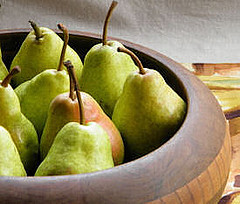
Cherries are the first to ripen in early June. My family eagerly looks forward to them and I’ve never had to try and preserve – they get eaten just as fast as I can gather. Then comes the apples in August. This year the golden delicious were fat and happy, enough to turn into pie and apple butter in addition to being eaten regularly fresh off the tree. The pears fall in September and there were plenty this year to process. These are hard cinnamon pears, not great to eat straight because they’re so tough even after sitting for a few days, so I make pear butter that needs very little sugar and is great on toast or mixed into hot oatmeal or cream of wheat.
The grape harvest starts with concords in early September and then muscodines later in the month. With those, I thought the fruit harvest was done for the year when I happened to discover now in mid-October a lone American persimmon tree [Diospyros virginiana] in the back corner of the yard behind the shed that is absolutely loaded. We’ve lived here 16 years and I never saw fruit on this 40-foot tall tree, so I guess it must have reacted to last year’s late freeze just like the other fruit trees did. Hmmm… what to do with persimmons?
Filed under Food Storage, Harvest, Homestead, Nutritition, Wild Foods, Yard | Comment (0)When the Fruit Salad Ripens
September 4th, 2008

The long summer drought finally ended last week with a full 12 inches from tropical storm Fay’s leftovers that sat stubbornly right overhead for three days. Pears are falling fast from the granny tree next to the driveway, being mashed into pulp every time a vehicle comes or goes and smelling so sweet it’s drawing flocks of turkeys and herds of deer. The fruit is hard and will dent the car if we park there, but I’ve a plastic helmet to protect my head for gathering. Which I’ve just gotta get busy doing before the bears show up.
Between the Granny pear and the house are the grapes, concords and muscadines quickly ripening but not quite sweet enough yet to justify harvest. That will come in mid-September, I’ll make jam, compote and wine (usually ends up as wine vinegar) this year, the basalmic from last year’s harvest is still aging.
Filed under Food Production, Food Storage, Harvest, Homestead, Nutritition, Recipes | Comment (0)Fun With Heirloom Tomatoes
July 25th, 2008

Now that I’m over that nasty bout with salmonella-laced foreign tomatoes, I must say I’m delighted that my own heirlooms are finally turning red in the garden, providing the sweetest, meatiest, most desirable fruit/veggie on the planet. Since the FDA rescinded its warnings due to the sudden availability all over America of actual locally-grown tomatoes, we can talk about what to do with all that juicy incoming bounty.
Processing tomatoes for preservation (or just for making dinner) is a messy job. That’s why I planted varieties this year that are known more for their usable inner ‘meat’ than their juice and seeds. Plus it’s been a bit dry this season, so too much water definitely isn’t their issue. When it comes time to do the processing, you may wish to do what I do and use the back deck grill instead of the kitchen stove to boil those large amounts of water. No air conditioning here, it’s usually not necessary and is a total waste of ‘trons. But when you’ve got big pots of water boiling in the kitchen for long periods of time, even the most mellow of summer mountain weather can quickly become unbearable.
Here are the basic prep steps for processing fresh tomatoes:
1. Wash all your tomatoes in running cold water. Even if you never use pesticides or pepper spray on them, washing is always a good idea (unless you’re eating tomatoes while out there picking them).
2. Put tomatoes in rapidly boiling water for 10-20 seconds, until you see the skin split. Remove quickly and put them in cold water (I fill up the sink with cold water ahead of time). This stops the cooking and further loosens the skins.
3. Cut the parboiled tomatoes in half and cut out the stem-end core, pull off the skins. Then quarter, squeeze out the seeds, seed membranes and juice into a compost container or bowl (from which you can later extract seeds to save and juice to drink).
4. Put the peeled and seeded tomato quarters (or pieces, if you chop further) into a colander or sieve to drain more moisture. I usually sprinkle salt on them at this point, it helps to get the moisture out.
Filed under Cultivated Herbs, Food Safety, Food Storage, Garden, Harvest, Homestead, Recipes | Comment (0)More Home Made Condiments
June 17th, 2008
Walnut Ketchup and BBQ Sauce/Marinade

I have no nut trees on my property other than the oaks from which I get acorns in the fall, and hickory nuts that you need a hammer and rock to crack. But my son-in-law has four walnut trees on his property, from which I collect sacks of walnuts both in the summer (when they’re green) and in the fall (after they’ve fallen).
So in case you’ve a source for green walnuts, I thought I’d offer a recipe for walnut ketchup that can’t be beat!
Walnut Ketchup
About 100 immature walnuts, shelled and crushed
2 quarts cider or malt vinegar
1/2 cup kosher (non-iodized) salt (can substitute 2/3 cup dark soy sauce)
Put these ingredients into a crock and cover, stir it daily for 8 days. Sieve out the liquid and put into a large pot with…
Filed under Food Production, Food Storage, Garden, Harvest, Recipes, Wine | Comment (0)Feeding The Hungry – Part 3
May 21st, 2008
The Rural “Shares” Project

At last, we come to our current hunger project, begun some years ago and still going quite strong. It’s not something governmental or bureaucratic, it’s not something designed to guard food against anyone deigned to be “undeserving,” and it gets a lot of help here and there from community groups. All without publicity, without bragging, without self-importance, without insults to the hungry, without too much time and trouble by anyone. It’s just a project people here know about and many of them contribute to in their own quiet ways – a bit like stashing bags of food (then also clothes and toys and blankets) behind the dumpsters in a sneaky sort of way so the Dumpster People were taken care of and nobody talked about it at all. It just happened, because…
“This Is America. No One Should Go Hungry.”
We call it “Shares.” Because sharing is really what it’s all about. Our personal end of it only works in growing/harvest season, the off-season stuff is handled by actual community groups (Chamber, Ruritan and a few church-lady groups), but still quite informally. They took that over all on their own, and I’m just fine with that. Heck, I never told them not to make it formal, they figured that out on their own too. They just wanted to keep it going through the winter and spring, so did.
The way it was conceived to work was to simply enlist the aid of the people in our area who always grow a nice veggie garden in their ample yards. Here along the slow end of the Blue Ridge it seems like everybody gardens, some more than others, in or outside of town.
At first I approached my immediate neighbors, nice folks who live this far out in the woods as I do on purpose. The leave us alone, but are always on hand in emergencies (blizzards, forest fires), and not stingy on good advice about what to do for apple blight, what’s eating the grape vines, the best heirloom tomato seeds, etc., etc. After the county locked up the dumpsters I approached 4 neighbors the following spring and asked if they’d add a row to their normal garden, seed it with any extra seed they had after planting their usual rows, and donate the produce to my “shares” project.
I told them I’d collect the food, bag or box it, and get it to those I knew in town (at that little grocery store) who could get it out to poor families. I wasn’t really surprised when they enthusiastically said ‘yes!’ but I was quite encouraged that this might work. The really amazing part is that I didn’t actually have to do the organizational work at all, even in the first year! Before spring was over those neighbors had convinced more neighbors, who convinced more neighbors, who got the word out in town, which started the little old church-ladies going, which got the Chamber involved, and the extension service jumped right in with both feet and started donating seeds – just pick ‘em up, free to all. It sort of just made so much sense that it took on a life of its own.
Continue reading »