- Leeks, Beets & ‘Extra’ Weeks
- Spring? Already?
- A Merry Christmas Re-Post
- Can Job Stress Kill?
- Dessert Fads in 2011
- Best Thanksgiving Perk: Cranberries
- 4 Safety Features That Lower Car Insurance
- Things to Do with Fallen Leaves
- Another Autumn Goodie: Rosehip Syrup
- Woodstove Maintenance
- Activities
- Agritourism
- Alternatives
- Barter
- Biofuels
- Building
- Cash Crops
- Cheesemaking
- Community
- Conservation
- Container Gardening
- Cooling
- Cooperatives
- Cultivated Herbs
- Dairy
- Doors
- Economics
- Education
- Emergency Preparedness
- Endangered Species
- Energy
- Environment
- Family
- Farm Policy
- Finance
- Food Preservation
- Food Production
- Food Safety
- Food Storage
- Future Planning
- Garden
- Glazing
- GMOs
- Goats
- Harvest
- Health
- Heating
- Herbal Medicine
- Holidays
- Home Buying
- Home-Products
- Homestead
- Hunger
- Independence
- Indoor Plants
- Jobs
- Landscaping
- Livestock
- Log Construction
- Maintenance
- Medicine
- Money
- Monsanto
- Nutritition
- Pets
- Planters
- Pollution
- Porch Plants
- Rare Plants
- Recipes
- Recycling
- Renovating
- Repair
- Rural Development
- Schools
- Soap Making
- Solar
- Sustainable Living
- Taxes
- Timber
- Time-Management
- Tools
- Trade
- Transportation
- Uncategorized
- Vacations
- Water
- Wild Foods
- Wild Herbs
- Wind
- Windows
- Wine
- Yard
- January 2012
- December 2011
- November 2011
- October 2011
- September 2011
- August 2011
- July 2011
- June 2011
- May 2011
- April 2011
- March 2011
- February 2011
- January 2011
- December 2009
- November 2009
- October 2009
- September 2009
- August 2009
- July 2009
- June 2009
- May 2009
- April 2009
- March 2009
- February 2009
- January 2009
- December 2008
- November 2008
- October 2008
- September 2008
- August 2008
- July 2008
- June 2008
- May 2008
- April 2008
- March 2008
- February 2008
- January 2008
- December 2007
- November 2007
- October 2007
- September 2007
- August 2007
Corporate Food & Human Backlash
September 26th, 2011

FDA, via AP
The current collapse of the world financial system has revealed some structural problems in our national economy that have flourished over a period of decades as corporate interests bought politicians and lobbyists to craft legislation to remove legal roadblocks to mass theft and market manipulation. And despite some changes in the D.C. political landscape, our government remains apparently helpless to do anything about corporate malfeasance on any level. With all the bad economic news dominating the public consciousness, some issues in the food supply sector are having a difficult time being properly correlated and attended to despite the serious level of danger they present to public health.
The food supply issues didn’t begin with the market manipulations on Wall Street and from there to exchanges all over the world. Though for many people the first alarms went off as the CDS fraud crashed the economy in 2008 and the financial players went looking for other markets to wreak havoc on. They seized on commodities – staple foods from the agricultural sector increasingly dominated by multinational corporations like Monsanto, ADM and Cargill. As a traceable beginning in 2008 to what this year became the “Arab Spring” movement across North Africa and spreading to the Middle East and southern Asia, food riots broke out in Egypt and Syria and portions of India as well as elsewhere when people could no longer afford to feed themselves and their families. Things have only gotten worse in the years since, and Americans are slowly waking up.
Filed under Alternatives, Community, Cooperatives, Economics, Education, Family, Food Production, Food Safety, Garden, Health, Homestead, Hunger, Livestock, Monsanto, Nutritition, Pets, Rural Development, Sustainable Living, Trade | Comment (0)Homestead Tools: Weaponry
September 6th, 2011
The very idea of weapons – particularly firearms – can generate some emotional reactions from people who like to think about homesteading as some sort of idyllic back to the land type movement for the terminally idealistic. As opposed to a committed, hard-working and independent lifestyle aimed at handling as much harsh reality as nature (and sometimes society) care to deal out.
Yet as is true of all the ‘best’ tools to amass for homesteading purposes, the question of what type of weaponry one may need is tied to what type of situations any weapon will be expected to deal with. Sometimes that may mean firearms. The homesteader will have to take into consideration what types of wild animals are most likely to be encountered in their location, whether or not someone in the family hunts for food, the likelihood of having to put down injured livestock, and any property or personal protection needs the family may encounter. In many cases the best tool for the job – and the person wielding the tool – could be a BB or pellet gun. Which is surprisingly effective at discouraging bears from the trash or compost without actually hurting them so as to leave an injured bear on the property (a real, live danger). These can be well less than deadly, but also come with CO2 cartridges that can turn them into effective small game/bird hunting weapons.
Filed under Emergency Preparedness, Environment, Family, Future Planning, Homestead, Independence, Livestock, Tools | Comment (0)Livestock: A Rabbit In Every Pot
July 26th, 2011
I’ve been looking into the various classified ads locally for livestock I want, to get an idea on budgeting first for proper quartering and actual animals. Chickens are of course a first choice. Also want bees, been looking at hives and queens for sale. If I can site them properly, bears shouldn’t be too much of a problem. Goats are sometime in the future, will need more fencing than we’ve got.
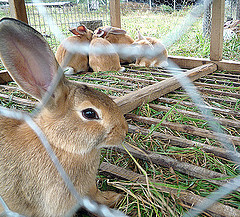
On those classified pages I discovered an awful lot of meat rabbits for sale, and remembered some homesteader friends in Virginia about 25 years ago who were big into meat rabbits. At the time we’d recently become vegetarian and I rejected the idea for our just-started homestead, but all these years later I think the ease of raising rabbits might make them an excellent livestock choice… so long as I don’t have to be the one who slaughters and prepares them for sale. There are surprisingly ample markets locally for good rabbit meat, especially organically raised. Even including some of the high-end eateries and B&Bs who are my regular fresh organic herb and sauce customers.
Filed under Alternatives, Cash Crops, Economics, Food Production, Future Planning, Homestead, Independence, Livestock, Nutritition | Comments (2)Something a Little Different: Homemade Pet Foods/Treats
April 13th, 2011
As the situation in Fukushima, Japan is not getting any better – thus the bulk of my terraces aren’t yet tilled and crops not yet planted – I thought it might be a good time to talk about something different. Homemade pet foods and treats! Not just leftover tuna for the cats, or plate-licking for the pooches, but real, honest to goodness pet foods and treats you can make in the kitchen for your furry housemates.
The last couple of years have been tragically tainted with the scandal of Chinese protein imports containing more melamine (a plastic they make dinnerware out of) than actual protein. It is estimated that hundreds of thousands, possibly millions of pets died painfully in the wake of the scandal, and babies who got melamine in their infant formula suffered and died as well. So for many animal-lovers, having some ready recipes for tasty, nutritionally balanced (even vegetarian!) pet foods and treats will be welcome.
On our homestead we have 1.5 dogs (our shepherd/lab mix Lady Starfish and McDuff the Border Collie who spends half the year with us), 4 cats and two birds. Someday we want chickens and goats, but we’re going to need some serious bear and fox proof fencing first. These are the pets. We feed the dogs and cats a diet exclusively of dry, higher end food. Through the years we’ve had various vets and other experts explain why this is a better diet than cans of by-products. Avoiding kidney problems in older animals and dental caries (not to mention ‘dog breath’) is good enough for me.
If you read the labels on various mid-range and high end ‘diets’ by major manufacturers, you will find what might be a surprising amount of grains and vegetables. Even though dogs and cats are indeed carnivores, they – dogs much more importantly than cats – need some plant foods as well. Most pet owners know that their animals will eat dinner leftovers with relish and grass/weeds when they’re feeling ill, but it’s good to know what kinds of grains and vegetables are best digested. And what kinds of foods to strictly avoid. Some of the recipes below give a good indication of that.
First, here are some good links to recipe and sharing sites that offer a variety of foods, snacks and other nifty pet things (like dog shampoo, toys, cat litter and more) that you can produce at the homestead.
Savvy Homemade: Pet Food, Treats and More
Healthy Recipes for Pets
Home Cooked Pet Diets
The GW Issue Few Wish to Hear
November 9th, 2009
Most environmentally aware people try to keep up with the science, the debates, and the drafting of policy that will hopefully address Global Climate Change (a.k.a. Global Warming). The hope is that we can diminish human contributions to greenhouse gases before the planet becomes unlivable. Things like developing energy sources that don’t require raping the earth or poisoning the air and water (Mountaintop Removal) or never-ending oil wars, conservation at home and at work, switching urban transportation fleets to biodiesel, purchasing hybrid cars, commitments to rebuilding infrastructure such as the electrical grid so it doesn’t ‘lose’ nearly half of our generation capacity, ending the decimation of tropical rainforests, etc.
And many of the people young and old who are paying attention and doing what they can to mitigate their own carbon footprints are also well aware that with some tweaking of our antiquated agricultural policies that were originally designed to ‘beat’ the Soviets in some kind of mock Cold War game of who can produce the most corn, we could be saving 20% of our fossil fuel consumption simply by switching the nation’s primary shipping systems – trains, ships and semi fleets – to biodiesel made with alternative feedstock crops. Along with our agricultural machinery. A combine can run just fine on biodiesel – or, with a pre-heater refit, straight vegetable oil.
Yet there’s a huge contributor to climate change that people don’t seem to be particularly aware of or take seriously as far as choices they could make to lessen their own impact. It’s not about carbon dioxide, which is the primary focus of most attempts to mitigate Global Warming, but about other greenhouse gases like nitrous oxide and methane. For these the agricultural sector is again the most significant contributor, and it all revolves around our hard-to-kick habit of eating way too much meat.
Filed under Alternatives, Energy, Environment, Farm Policy, Food Production, Health, Livestock | Comment (0)Livestock on the ‘Stead
May 6th, 2009

AP/Eric Risberg
In view of recent weeks’ events concerning an off-season outbreak of a new flu strain in Mexico that quickly spread around the world – and caused WHO to get all the way to 5 on its pandemic alert system before things eased somewhat – it’s a good idea for those of us in the 21st century’s “back to the land” movement to examine some issues with livestock production in general and how we get around those issues on our own homesteads. Many homesteaders avoid livestock, but many others keep chickens, a cow or more, goats, pigs, rabbits, and some pasture a few calves every year destined for the organic beef market. What does all this mean for us?
Thus far the new flu strain, which according to the CDC is a “unique” mixture of human, avian and swine flu strains, looks to have originated in the CAFO [Concentrated Animal Feeding Operation] system of swine production for human food. These operations, where thousands of animals are confined in close quarters and intensively fed for maximum weight gain in minimum time, can according to researchers and epidemiologists serve as fertile genetic recombination factories for the various strains of influenza due to lack of good waste management practices and regulation, proximity of swine CAFOs to avian CAFOs, water contamination, worker contact with infected animals. Add to that the difficulty of dealing with viral rates of mutation as well as getting effective vaccines into production from one year to the next, and you end up with a situation of concern not only to public health authorities, but also to small producers who happen to live anywhere close to such intensive CAFO operations.
Filed under Food Production, Future Planning, Homestead, Livestock | Comment (0)Is It a “Fish Farm” if I Stock the Creek?
November 20th, 2008

Now that the weather’s turned officially cold and the wood stove is going all day and night, there’s time to reflect upon the year and make new plans for the future. I’m still working on how to get “free range” chickens that won’t get eaten by the many foxes and coyotes that haunt our cove, sans the serious fencing we can’t afford. Also working on finding some metal fence poles for the garden fence through our local Freecycle network, nobody’s willing to come off any so far.
I find my mind once again drifting toward renting a backhoe for a week and dredging down in the creek so I’ll have a set of three tiers of pond that I can stock with rainbow trout. So I’ve been looking into the whole aquaculture thing, the issues with pollution and antibiotics and quality of feed, cost of fingerlings from the state, etc. What kind of engineering do I have to do to my creek? What kind of pollution controls? Who gets to police my little trap-falls?
After two days’ worth of homework, I’ve decided that my plan doesn’t fall under the regulatory purview of the state beyond their “stocking rivers and creeks” section. Yes, since it’s private land I’ll have to pay for the fingerlings, but because these pools won’t be anything but slightly-dammed hold-backs the size of my back deck, there should be no issues about waste pollution or anything like that. I will probably need a permit from the state in order to get the fingerlings, but once they’ve determined the operation is so minor as to not really qualify as “commercial,” it shouldn’t cost that much. Sell a few dozen fish a year.
Filed under Cash Crops, Food Production, Future Planning, Garden, Homestead, Livestock | Comment (0)Letter to the New Farmer in Chief
November 6th, 2008

There is a resurgence of hope across America in the wake of Tuesday’s election of Democrat Barack Obama as President, promising a new direction of change for the future of our nation. Those of us who have been paying attention to the global financial meltdown, increasingly severe food shortages in the wake of global warming, and the outrageous poisoning of our citizens and livestock/pets by corrupt Chinese producers (a glaring example of globalization’s failures), are hoping that a new dawn in America will bring with it the serious changes to our agricultural policies that have grown increasingly necessary through decades of decline.
Now, politicians don’t generally talk much about agricultural policies while they’re stumping for votes in big cities. And they’re often so ignorant of agricultural issues that even rural dwellers – actual farmers – get nothing but pablum and platitudes in response to their questions. Luckily, journalist Michael Pollan wrote a great ‘open letter’ in the New York Times in October entitled, Farmer in Chief. This is a must-read for all of us committed to self-sufficiency, locally grown foods, the viability of family farms and homesteads, and the future health of an environment we all depend upon for life.
Filed under Alternatives, Conservation, Cooperatives, Economics, Environment, Food Production, Food Safety, Future Planning, Health, Hunger, Independence, Livestock, Pollution, Rural Development | Comment (1)Home Made Goat Cheese… Yum!
April 2nd, 2008

As we prepare to replace the fence posts and fencing around the garden, I’ve been considering a fenced area on the other side of the garden, or perhaps on the upper terraces, for a chicken coop, a little barn-shed and a couple of milk goats. It would be a big step for us to go into livestock (that’s not dogs, cats or doves), but with the food shortages expanding and the prices rising fast, it might be something that makes good sense.
The folks we bought this place from some 15 years ago raised goats and horses, also kept bees. I’d love to get some bee boxes, know right where to station them at the edge of the woods facing the garden. But we’ve plenty of wild bees and other insect pollinators for the fruit and vegetables and wildflowers. I’d be doing it for the honey! Chickens will have to be well protected from foxes (we have a couple of fox families on the property, and we don’t plan to kill them). We used to keep chickens in the fenced back yard of a house in town when I was a kid, they aren’t difficult if they’re protected.
My experience with goats hasn’t been so encouraging. Got our first goat in Virginia from a friend. She was half alpine, half Nubian, the cutest critter God ever made! All legs and full of energy. By the time she’d grown up enough to breed (yes, they have to be bred regularly in order to give milk), she was convinced she was a dog. Who ever heard of milking a dog? She made an great pet, but we never had her bred.
Filed under Cheesemaking, Cultivated Herbs, Dairy, Future Planning, Goats, Homestead, Livestock | Comments (8)